The day after a major role ends is strangely ordinary.
The alarm clock still works. The phone still lights up. The rest of the world continues moving. But the place where you were expected to be may no longer expect you. The title people used for you may no longer apply. A routine that once organized your days can disappear almost overnight.
People often ask, “What are you going to do next?”
Sometimes the harder question is quieter:
Who am I now that I am no longer who I was there?
I have moved through enough transitions to know that a role change can reach much deeper than a resume. Whether the ending involves a career, retirement, a relationship, caregiving, health, military or public service, or another identity-heavy part of life, the loss is rarely limited to responsibilities.
It can also take structure, belonging, recognition, confidence, community, and a familiar source of purpose.
That is why some transitions feel less like change and more like disappearance.
Roles Give Us More Than Work
A meaningful role tells us where to be, what matters, who depends on us, and how we know whether we are doing well. It gives us language, relationships, standards, and often a sense of being useful.
When that role ends, other people may see an open calendar or a new opportunity. The person living through it may feel the loss of an entire operating system.
That loss should not be minimized.
None of this restores lost income, health, status, relationships, or community. Identifying strengths does not cancel grief. A major ending can be painful even when it eventually creates room for something new.
The first honest step is not to rush past that pain. It is to recognize that the role mattered.
But the role is not the whole person.
A title is a container for your contribution. It is not the source of your worth.
What the Role Developed in You Still Belongs to You
Moving beyond law enforcement required me to separate the work I had done from the person the work had helped shape.
I could not carry the badge into every environment that followed. I could carry discipline, judgment, accountability, calm under pressure, and a commitment to serve. Those qualities did not become invalid when the title changed. They simply needed a new place to operate.
That distinction matters.
A company does not own your judgment. A uniform does not own your courage. A position does not own your ability to lead. A relationship does not own your capacity to care. A season of good health does not own your determination.
Roles can end. What they developed in us can remain.
The work is learning how to separate the two.
I have come to think of that work as a three-part discipline:
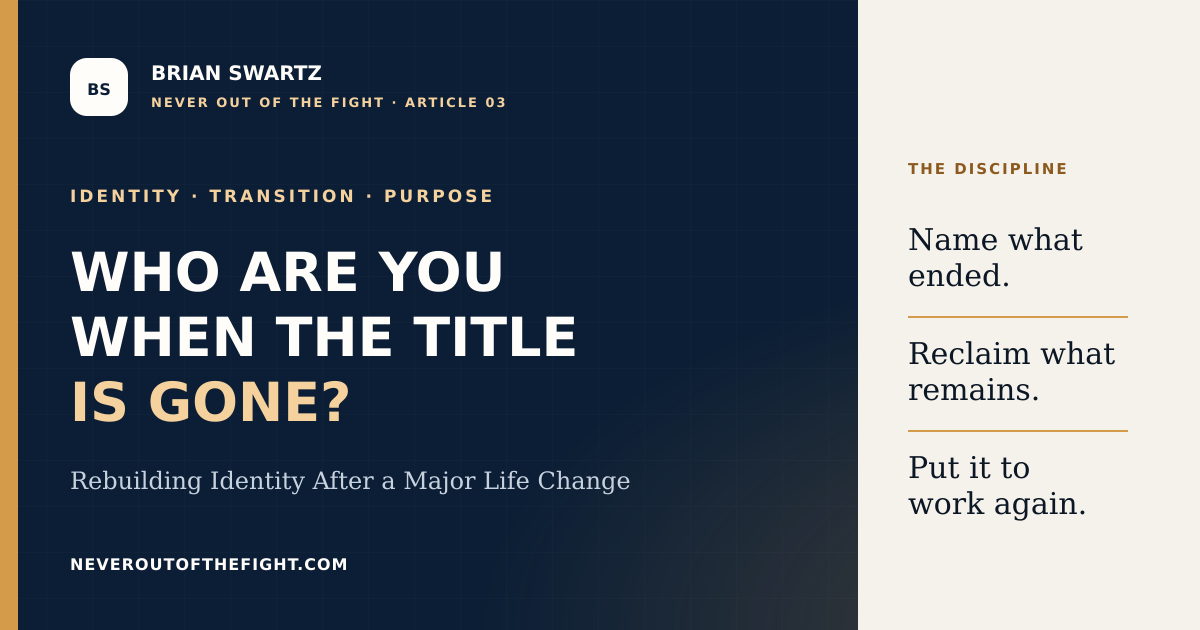
Name what ended.Reclaim what remains.Put it to work again.
Name What Ended
Vague loss is difficult to carry because it can feel like everything is gone. Specific loss can be acknowledged, grieved, and understood.
Be honest about what ended. Was it the paycheck? The authority? The camaraderie? The schedule? The mission? The sense that other people needed you? The confidence that came from knowing exactly how to do the work?
You may miss the role itself. You may miss who you were while performing it. You may also miss how other people saw you.
Naming those losses is not dwelling on the past. It is telling the truth about the weight of the transition.
You cannot rebuild honestly around a loss you refuse to name.
Reclaim What Remains
After naming what ended, ask a different question:
What did that role develop in me?
Not what was printed on the business card. Not what appeared on the organizational chart. What did years of showing up, solving problems, caring for people, making decisions, recovering from mistakes, and carrying responsibility build inside you?
Maybe it developed patience, courage, technical judgment, empathy, discipline, advocacy, adaptability, or the ability to bring calm into a difficult room.
Those qualities are not consolation prizes. They are evidence.
They show that the role left you with more than memories. It left you with capacity.
This is where identity begins to widen. Instead of saying only, “I was a manager,” you may be able to say, “I know how to create clarity when people are uncertain.” Instead of only, “I was a caregiver,” you may recognize, “I know how to advocate, organize, endure, and remain present when life is difficult.”
Titles describe where we contributed. Values and capabilities describe how we show up.
Put It to Work Again
The third step is not to recreate the old role under a different name. It is to find one place where what remains can become useful again.
That place may initially look smaller than the role you lost. It may not come with status, compensation, recognition, or certainty. It might be mentoring one person, learning a new system, volunteering, returning to school, supporting a family member, accepting an unfamiliar assignment, or helping a team solve a problem no one else wants to own.
Do not mistake a smaller stage for a smaller contribution.
Contribution can return before confidence does. It can return before the next title does.
The goal is not to prove that the ending did not hurt. The goal is to create evidence that your ability to matter did not end with it.
A Simple Identity Inventory
Take a blank page and write three short responses.
The role I held: Name the role without embellishment.
What it developed in me: Identify the values, capabilities, relationships, and lessons that became stronger because you carried that role.
Where it can serve now: Choose one real person, problem, responsibility, or opportunity where one of those qualities could be useful this week.
For me, one line might read: law enforcement; calm judgment and accountability under pressure; leading people and making decisions in complex operations.
The environments are different. The contribution still has a recognizable thread.
This exercise does not answer every question about the future. It does something more immediate: it proves that an ending did not erase everything that came before it.
What Leaders and Organizations Should Understand
This matters beyond the individual.
Layoffs, reorganizations, retirements, promotions, medical leaves, and major role changes are not only staffing events. They can be identity events.
Good leaders do not try to motivate people past that reality. They acknowledge what is being lost, preserve dignity, and help people translate experience into a future contribution.
That may mean asking better questions: What strengths did this role require? What did this person become capable of here? Where else could that capability create value?
Organizations are better at managing transitions when they treat people as more than the positions they occupy.
You Do Not Need a Leadership Title for This Work
You may not see yourself as a leader. That is not required.
Identity rebuilding happens in homes, hospitals, classrooms, support groups, job searches, recovery programs, retirement, and ordinary days when someone is trying to understand what remains after life removes something important.
The discipline is the same.
Name what ended.Reclaim what remains.Put it to work again.
Never Out of the Fight Does Not Mean Never Letting Go
Sometimes staying in the fight requires releasing a title that can no longer hold you.
You are allowed to miss the person you were in that role. You are allowed to grieve the structure, relationships, and meaning that came with it. You can honor that identity without remaining trapped inside it.
The role may be over.
Your capacity to serve, learn, care, build, decide, and contribute is not.
So if you are standing between who you were and whoever you are becoming, do not force yourself to have the entire answer today.
Start here:
Name what ended.Reclaim what remains.Put it to work again.
Who are you when the title is gone?
Still someone with something to give.