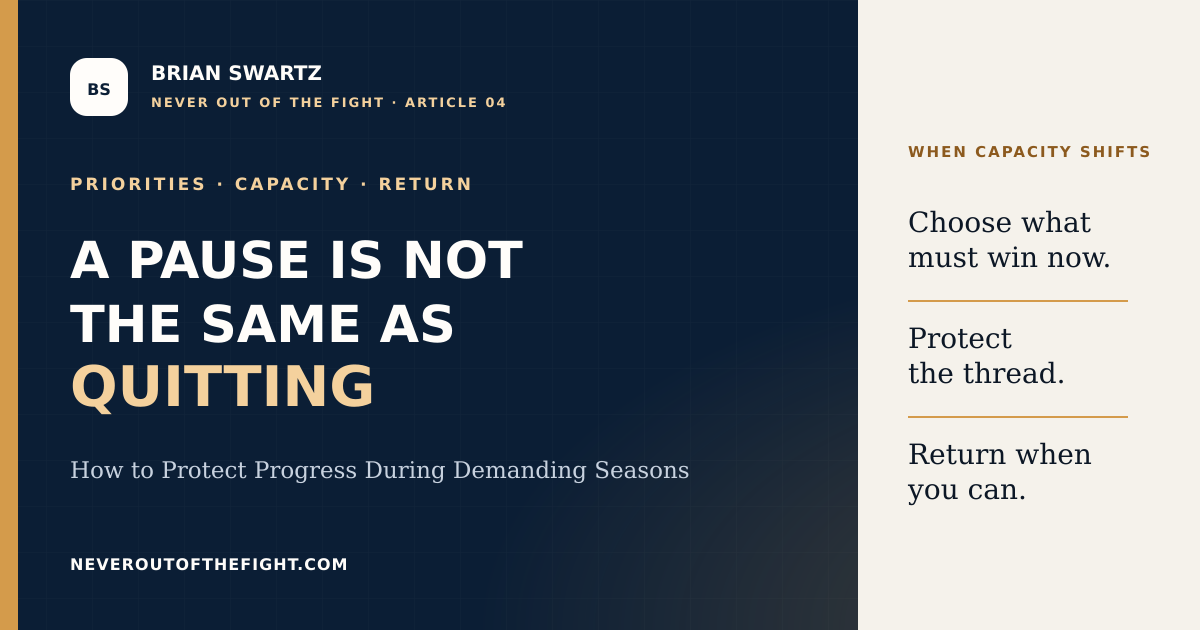
For the past two weeks, I did not publish an article.
I had planned to. The topics were waiting, the platform mattered to me, and I wanted to maintain the momentum I had started building.
Then the demands of my final MBA semester increased, and something had to give.
That gap could be described as falling behind. For a few moments, it felt that way. But missing a self-imposed publishing schedule was not the same as abandoning the work. It meant that another responsibility needed my attention first.
Many people carry several important commitments at once. Work matters. Family matters. Health matters. Education matters. The future we are trying to build matters. The problem is that all of them can matter without all of them receiving equal attention at the same time.
Maturity is recognizing when the pace has to change without mistaking that change for failure.
Commitment is not measured by uninterrupted visibility. It is revealed by whether we return to what matters.
When Everything Cannot Be First
One of the easiest ways to become overwhelmed is to treat every meaningful goal as an immediate priority.
That sounds responsible, but it usually produces the opposite result. Attention becomes scattered. Important work receives partial effort. Rest begins to feel irresponsible. Even progress can feel inadequate because something else is always waiting.
Real priorities require choices.
During the past two weeks, school needed to move to the front. Publishing could wait. That did not make Never Out of the Fight less important. It meant I was protecting a commitment with a more immediate deadline.
The same choice appears in many forms. A parent may temporarily reduce professional development to care for a child. An employee may postpone a personal project during a demanding operational period. Someone recovering from surgery may need to measure progress in appointments attended and routines rebuilt rather than goals completed.
These are not excuses. They are decisions about limited time, energy, and capacity.
The difficult part is making the choice honestly. We should not call avoidance a priority decision. We should also stop calling every responsible adjustment a lack of discipline.
The Difference Between a Pause and Withdrawal
A deliberate pause has a reason. It also has some form of boundary.
Withdrawal is different. It often happens without a clear decision. One missed action becomes two. Discomfort grows. Returning begins to feel harder because we believe we owe everyone an explanation or need a perfect restart.
That is how a short interruption can quietly become an abandoned goal.
The answer is not to force equal effort into every area of life. It is to remain conscious of what we are setting down and why.
Before temporarily stepping back from something important, I have found it useful to answer four questions:
- What needs my strongest attention right now?
- What can wait without creating serious harm?
- What is the smallest action that will keep this commitment alive?
- When will I review the decision?
For this article series, the smallest action was simple: keep the next topic in view and return when the immediate school load eased. I did not need to pretend I had unlimited capacity. I needed to make sure the pause remained a choice.
A pause becomes dangerous when it has no reason, no boundary, and no return point.
Protect the Thread
When a full effort is not possible, protect the thread connecting you to the goal.
That thread may be a note on your calendar, a fifteen-minute practice session, one saved idea, a short walk, an appointment kept, or a conversation with someone who knows what you are trying to accomplish.
The action does not have to create visible progress. Its purpose is to preserve continuity.
This matters because restarting is easier when we have not emotionally separated ourselves from the goal. A small action reminds us that the commitment still belongs to us, even while most of our attention is somewhere else.
Protecting the thread is not a productivity trick. It is a way to be honest about capacity without surrendering direction.
Sometimes even the smallest action is too much. Illness, grief, exhaustion, or crisis can require a complete stop. In those seasons, protecting the thread may mean allowing another person to help, setting a future reminder, or simply refusing to interpret necessary rest as permanent defeat.
Return Without Apology
When we come back, many of us waste energy explaining the gap.
We think we need to justify why we were absent, apologize for losing momentum, or compensate by making an unrealistic promise about what we will do next.
Usually, the most useful response is much simpler: return and do the next piece of work.
The gap already happened. Shame will not recover the time. An aggressive restart may create another cycle of overcommitment and withdrawal.
I did not need to write three articles this week to make up for the two I did not publish. I needed to write the next honest article.
That principle applies far beyond writing. If you missed several workouts, take the next reasonable walk. If a difficult semester interrupted a professional goal, reopen the plan. If recovery changed your timeline, begin from your current condition instead of the condition you wish you had.
Returning does not require a dramatic declaration. It requires an action that fits reality.
What Leaders Should Understand
Leaders sometimes praise consistency without acknowledging capacity.
Standards matter. Deadlines matter. Other people depend on our follow-through. But strong leadership also requires judgment about which work must happen now, which work can move, and what support will protect the most important outcome.
When every assignment is labeled urgent, employees are not being given high standards. They are being denied priorities.
Leaders should make tradeoffs visible. If a new responsibility moves to the front, say what can move back. If a team member is carrying an unusual load, clarify the minimum outcome required during that period. If a deadline cannot change, help remove work that matters less.
This does not lower accountability. It makes accountability possible.
People are more likely to sustain good work when they understand what must win now and know they can raise a capacity concern before performance collapses.
A Sustainable Definition of Discipline
Discipline is often described as doing the work whether we feel like it or not. There is truth in that. Feelings cannot make every decision for us.
But discipline also includes recognizing when our current plan no longer fits our available capacity. It includes protecting critical commitments, reducing lower-priority work, and returning when conditions allow.
That version of discipline is less visible. It may not produce a perfect streak or a constant stream of public accomplishments. It does produce something more durable: progress that can survive real life.
Never Out of the Fight was never meant to describe constant motion.
There are times to push. There are times to recover. There are times to focus so narrowly on one responsibility that other valuable work must wait.
The pause is not the problem.
The question is whether we made it consciously, protected what mattered, and returned when we were able.
This article is my return.
What important goal have you had to pause so you could protect a more immediate responsibility? What helped you come back to it?
I would genuinely like to hear your story.